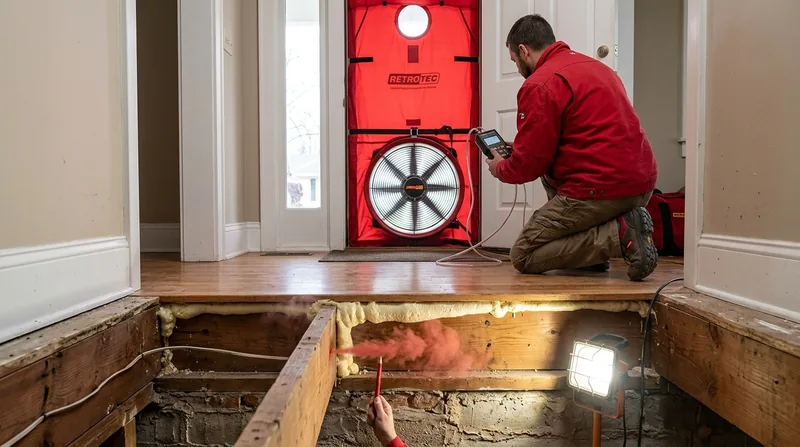




Fort Wayne's housing stock, from balloon-framed homes in West Central and Lakeside where heated air rises straight through open wall cavities into the attic, to postwar ranches with full basements across the south side, to newer two-story subdivisions with bonus rooms over garages, bleeds conditioned air all winter long. Air sealing in Fort Wayne stops that loss by finding and closing the leaks that matter most: top plates where heated air escapes into unconditioned attics, rim joists above basements and crawl spaces that let cold floors dominate a home's feel, and penetrations around ductwork and mechanical systems that bypass the building envelope entirely. In IECC climate zone 5A, where winters are cold and humid and summer moisture reverses pressure for a few months, a home that holds its air is a home that stays comfortable and costs less to heat and cool year-round. We run a blower door test to measure where the leaks are, then seal them with spray foam and caulk so your house holds conditioned air through every season. Attic spray foam insulation often pairs with air sealing to complete the envelope, but sealing alone can make a measurable difference in homes where the insulation itself is still sound.
Why Air Sealing Matters in Fort Wayne's Cold Climate
Fort Wayne winters push heated air outward through every crack and opening in the building envelope. Top plates in older balloon-framed homes sit above insulation that cannot seal the gap between the frame and the rafter, so warm air rises directly into the attic and out through the roof. Rim joists above basements and crawl spaces are notorious heat and cold leaks because they sit at the junction where the foundation ends and the floor system begins, and most homes have them sealed poorly or not at all. Ductwork running through attics and walls creates penetrations that bypass insulation entirely. The result is steady heat loss all winter, higher gas bills, and cold floors that no amount of thermostat adjustment will fix.
- We locate air leaks using a blower door test that depressurizes the house and shows exactly where conditioned air escapes.
- We seal top plates, rim joists, band joists, and ductwork penetrations with spray foam and caulk to stop the flow.
- We verify the seal with a follow-up blower door test to confirm the improvement in air tightness.
- We document R-value and thickness in the written estimate so you know what was installed and where.
Air sealing is the single biggest credibility differentiator between a spray foam contractor and a fiberglass installer, because fiberglass does not seal, it only insulates. In a Fort Wayne home with a leaky envelope, fiberglass alone will not stop the air movement that carries heat away.
Key info: The Indiana 811 utility locate system is required by law before any excavation, but air sealing work inside the home does not involve digging. Always call 811 before any exterior work, and verify that your local city or county permits apply. Fort Wayne's building department can answer questions about what permits your project requires at your address.
How We Seal Air Leaks in Fort Wayne Homes
Air sealing starts with measurement, not guesswork. We bring a blower door test to your home and run it under controlled conditions to find where the air is moving. The test shows us which leaks are costing you the most money and which ones we can reach and seal. Top plates in attics, rim joists in basements, and ductwork penetrations are the usual targets, but every home is different. Once we know where the leaks are, we seal them with spray foam where the gap is large enough to benefit from it, and with caulk and weatherstripping where sealing is tighter. We then run the blower door test again to confirm the improvement.
- We conduct an initial blower door test to measure air leakage rate and locate the dominant leaks.
- We seal top plates where heated air escapes into attics using closed cell or open cell foam depending on the cavity.
- We seal rim joists above basements and crawl spaces to stop cold air from rising into the floor system.
- We seal ductwork and mechanical penetrations to prevent conditioned air from bypassing the living space.
- We run a final blower door test to verify the improvement and document the new air tightness.
In a West Central Fort Wayne home with a balloon frame and an open attic, sealing the top plate can reduce air leakage by 30 to 40 percent on its own. In a postwar ranch with a basement and a leaky rim joist, sealing that joist stops cold floors and reduces heating load in the winter months.
Example: A 1950s ranch in Leo-Cedarville with a full basement and a vented attic had a blower door result of 8,500 CFM50 (cubic feet per minute at 50 pascals pressure). We sealed the rim joist above the foundation, the top plate in the attic, and three ductwork penetrations with closed cell foam. The follow-up test showed 6,200 CFM50, a 27 percent improvement. The homeowner reported warmer floors in winter and lower gas bills.
| Sealing Method | Description | Best for |
|---|---|---|
| Closed Cell Spray Foam | High-density foam with R-value of 6 to 7 per inch, rigid when cured, excellent air barrier and vapor barrier in one pass. | Rim joists, band joists, ductwork penetrations, and large cavities where structural support is beneficial. |
| Open Cell Spray Foam | Lower-density foam with R-value of 3.5 to 4 per inch, softer when cured, excellent air barrier but not a vapor barrier. | Top plates in attics, interior wall cavities, and applications where vapor permeability is desired for drying. |
| Caulk and Weatherstripping | Flexible sealants for small gaps, cracks, and seams where foam is not practical or cost-effective. | Window and door frames, electrical outlet sealing, and small penetrations around plumbing and wiring. |
| Blower Door Testing | Fan depressurization test that measures whole-house air leakage and locates dominant leaks with precision. | Baseline measurement before sealing, and verification after sealing to confirm improvement and air tightness. |
Each method has a place in a complete air sealing strategy. We choose the method based on the size of the opening, the location, the climate zone, and the long-term performance you need.
Air Sealing Cost in Fort Wayne: What to Expect
Air sealing cost in Fort Wayne depends on the size of the home, the number of leaks you want sealed, and the method we use to seal them. A blower door test and sealing of the top plate and rim joist in a typical ranch or split-level home starts at around $650 to $1,200. Larger homes, homes with more complex ductwork, or homes where we need to remove old insulation before sealing will cost more. The best way to know what your job will cost is to call us at (260) 264-8362 for a free estimate. We measure on site, identify the leaks, and give you a written estimate with R-value and thickness specs so you know exactly what you are paying for.
Factors that affect cost include the number of stories, the size of the attic and basement, the condition of existing insulation, and whether we need to remove and replace old insulation before sealing. A home with a vented attic and a finished basement will have fewer leaks to seal than a home with an open attic and a crawl space. Access matters too. If the attic is tight and ductwork is in the way, the job takes longer and costs more. See our full pricing overview for ballpark ranges on related services.
Getting 2 to 3 estimates from different contractors is always smart. You should see a blower door test result in each estimate, a written list of what will be sealed and with what material, and an R-value and thickness specification. If an estimate has no R-value, no thickness, and no list of what is being sealed, that is a red flag. We provide all of that in writing before we start.
What to Look for When Hiring an Air Sealing Contractor Near Fort Wayne
Air sealing is a technical job, and the difference between a careful installation and a careless one shows up in your utility bills and comfort for years. When you are comparing contractors, look for specific signs of competence and honesty. A professional contractor should run a blower door test before the job and after, so you can see the improvement in numbers. The estimate should specify what material is going in, the R-value and thickness, and exactly where it is going. The contractor should be fully insured and willing to provide proof of coverage. References from past customers matter, especially if those customers live in homes similar to yours in Fort Wayne or nearby towns like New Haven, Huntertown, or Leo-Cedarville.
- Ask for a blower door test as part of the estimate process so you can see where the leaks are and verify the improvement after sealing.
- Request a written estimate with R-value, thickness, and material type specified for each area being sealed.
- Verify that the contractor is fully insured and ask to see a certificate of insurance.
- Ask for references from past customers and call them to ask about the quality of the work and whether the contractor was responsive if issues came up.
- Confirm that the contractor understands local permitting requirements, which vary by city across Greater Fort Wayne and have no reciprocity between jurisdictions.
- Make sure the contractor explains the cure time and re-entry window (typically 24 to 48 hours) and what mechanical ventilation will be used during the spray process.
The spray foam trade includes both local independent shops and national franchises, and it also includes rig-and-run crews who spray a job in an afternoon and are gone before the smell fades. A local contractor with a local address, a reputation in the community, and a phone number you can call if something goes wrong is the safest choice. Contact us for a free estimate and references from Fort Wayne homeowners who have had air sealing done in homes like yours.
Air Sealing in Fort Wayne: Pricing Guide
| Service | Price | Details |
|---|---|---|
| Blower door test and top plate sealing | Starting at $650 | Includes baseline blower door test, sealing of attic top plates with closed or open cell foam, and verification test |
| Rim joist and band joist sealing | Starting at $800 | Closed cell foam sealing of foundation perimeter, including basement or crawl space rim joist and band joist penetrations |
| Comprehensive home air sealing | Starting at $1,200 | Top plate, rim joist, ductwork penetrations, and mechanical system sealing with full before and after blower door testing |
| Air sealing with insulation removal | On estimate | Projects that require removal of old or failed insulation before sealing command site inspection to measure scope and access |
| Travel and estimate | Included, free | No mileage fee in Fort Wayne and surrounding areas, free written estimate with 24-hour response at (260) 264-8362 |
Indicative pricing, the exact cost depends on square footage, finish, and site access. Free personalized estimate within 24h at (260) 264-8362.


