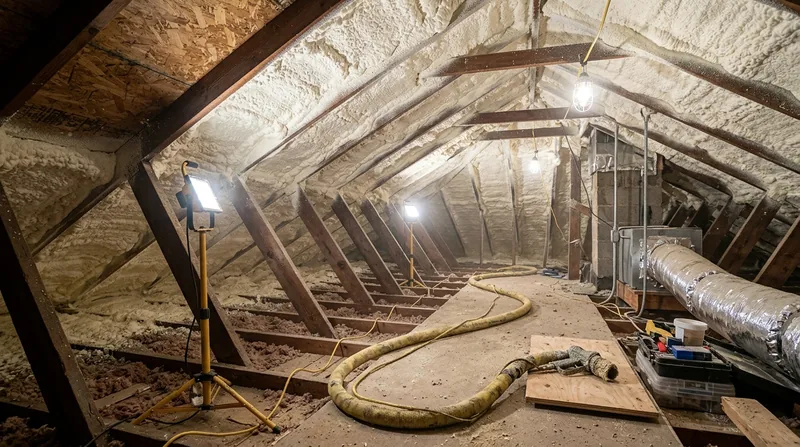




Insulation Replacement & Re-Insulation in Fort Wayne is the foundation of energy efficiency in homes where old, failed, or inadequate insulation has already been removed. Fort Wayne's housing stock spans from early-1900s balloon-framed homes in West Central and Lakeside, where open wall cavities and tight attics leak heat straight into winter, to postwar ranches with basements across the south side, to newer two-story subdivisions pushing toward Huntertown with bonus rooms over garages. This is IECC climate zone 5A: cold, humid winters that drive heated air outward through top plates and rim joists, and humid summers that reverse that pressure. After removal of failed fiberglass, cellulose, or damaged foam, Fort Wayne attics and walls need insulation sized for these winter and summer extremes. We re-insulate with spray foam to cut the heat loss common in balloon-framed and postwar homes, restore the air seal that blown-in insulation cannot match, and stop the condensation and thermal bridging that older materials allow.
Why Insulation Replacement Matters in Fort Wayne's Older and Newer Homes
Fort Wayne's mix of housing types means insulation failure shows up in different ways. Balloon-framed homes in West Central and Forest Park neighborhoods have open wall cavities and attics where fiberglass settled or compressed decades ago, leaving gaps and thermal bridges that no longer perform. Postwar ranches across the south and east sides often have fiberglass batts installed without air sealing, so rim joists above crawl spaces and basement sills stay cold and damp. Newer subdivisions near Aboite and Huntertown have bonus rooms over garages where insulation was never adequate to begin with, or where previous contractors left gaps around trusses and ductwork. Once old insulation is removed, the cavity is bare and the air seal is broken. Re-insulation with spray foam closes both gaps at once.
- Spray foam fills irregular cavities and follows the shape of attic trusses, rim joists, and wall studs without settling or compressing over time.
- The foam itself acts as an air barrier, stopping the convective heat loss that blown-in materials cannot prevent.
- Closed cell foam adds structural rigidity to roof decks and resists moisture in crawl spaces and basements where humidity is constant.
- Open cell foam is lighter, less dense, and more affordable for attics in dry climates or where vapor permeability is needed.
- Re-insulation after removal eliminates the risk of trapping old contamination or failed material beneath new insulation.
Choosing the right insulation type and thickness after removal is the difference between a cold attic and a conditioned one, and between a damp crawl space and a dry one.
Key info: Fort Wayne homes in zone 5A typically need R-38 to R-49 in attics and R-13 to R-21 in walls, depending on whether the wall is interior or exterior facing. Crawl spaces and rim joists above grade need closed cell foam or a continuous air barrier to stop winter heat loss. We size every re-insulation job to local code and the specific cavity being filled, with written estimates that state R-value and foam thickness in inches.
For more detail on how different foam types perform in Fort Wayne's climate, see our pages on closed cell spray foam insulation and open cell spray foam insulation.
How We Handle Insulation Replacement: From Removal to New Foam
Re-insulation starts where removal ends. Once old insulation is out, we inspect the cavity for air leaks, moisture damage, and structural issues. We seal rim joists, top plates, band joists, and ductwork penetrations with foam or caulk before applying new insulation. In Fort Wayne attics, we often find gaps around where old vents were installed or where settling has opened seams between wall sections. We close those first, then apply foam to the full depth and R-value required by code at your address. The process is straightforward but requires site-specific planning, because every attic in a West Central Victorian is different from every attic in a Leo-Cedarville ranch.
- We inspect the cavity and substrate for moisture, mold, or structural damage before any foam is applied.
- We seal air leaks around penetrations, top plates, rim joists, and ductwork using foam or compatible sealant.
- We apply spray foam in controlled passes to the thickness and R-value specified in the written estimate.
- We provide mechanical ventilation during cure to manage off-gassing and ensure proper curing of the foam.
- We observe a re-entry window of twenty-four to forty-eight hours before the space is occupied or covered.
- We document the installed thickness and R-value on a completion form for your records and any future inspection.
The result is an insulated cavity with no gaps, no settling, and an air seal that lasts as long as the home stands.
Local example: A balloon-framed home in Fort Wayne's Lakeside neighborhood had its attic fiberglass removed due to settling and moisture. The open wall cavities in the second floor were exposed. We sealed the top plates and rim joists, then filled the walls with closed cell foam to R-15, and the attic to R-49. The homeowner's gas bill dropped and the upstairs bedrooms stayed warm through the winter without cold spots at the corners.
For more on air sealing and how it complements re-insulation, visit our air sealing page.
Re-Insulation Methods and Materials
| Approach | Description | Best for |
|---|---|---|
| Closed Cell Spray Foam | High-density foam, 1.5 to 2.0 lbs/cu ft, R-6 to R-7 per inch. Rigid, moisture-resistant, structural. | Crawl spaces, rim joists, basements, sealed attics, metal buildings, and any cavity where moisture or vapor drive is present. |
| Open Cell Spray Foam | Low-density foam, 0.5 lbs/cu ft, R-3.5 to R-3.8 per inch. Flexible, breathable, sound-dampening. | Attics in dry climates, interior walls where noise control is desired, and bonus rooms where cost is a factor. |
| Blown-In Cellulose or Fiberglass | Loose-fill material, R-3.2 to R-3.8 per inch. Low cost, settles over time, no air seal. | Top-up of existing sound attic insulation where air sealing is not a priority and budget is tight. |
| Injection Foam into Closed Walls | Low-pressure foam injected through holes in rim boards or wall plates. Minimal disruption, fills cavities without demolition. | Pre-1980 homes with empty wall cavities, Fort Wayne ranches, and historic homes where interior or exterior finish must stay intact. |
Insulation Replacement & Re-Insulation Cost in Fort Wayne: What to Expect
Re-insulation cost depends on the size of the cavity, the foam type chosen, the R-value required, and the complexity of air sealing. A typical attic re-insulation in a Fort Wayne ranch home runs from $2,800 to $5,500, depending on whether the attic is a simple rectangular space or cut up by trusses and ductwork. A crawl space or rim joist project starts lower because the area is smaller, but the access and moisture conditions often add labor. Wall injection into a closed cavity in a postwar home is priced by the board foot of foam, typically $1.50 to $2.50 per board foot depending on foam type and wall depth. Multiple estimates are smart because the scope and air sealing requirements differ from house to house.
- Attic re-insulation in a 1,200 sq ft ranch home with R-49 open cell foam typically costs between $3,200 and $4,500.
- Rim joist and basement band board sealing in a 1,000 linear foot foundation runs $1,800 to $3,000 depending on depth and access.
- Wall injection into a pre-1980 closed cavity runs $0.80 to $1.20 per board foot of foam, plus setup and access charges.
- Bonus room insulation over a garage in a newer subdivision is often a smaller scope, $1,500 to $2,500, because the cavity is smaller but access may require temporary covering of living space.
- Travel and setup are included in Fort Wayne and surrounding areas; no separate mileage fee is charged.
Every estimate includes the R-value, foam thickness in inches, and the board foot total, so you can compare fairly across contractors. See our pricing page for more detail on how different scopes are estimated.
Insulation Replacement & Re-Insulation Near Me: What Fort Wayne Homeowners Should Know When Hiring
Hiring a spray foam insulation contractor for re-insulation work is a decision that affects your home's comfort and energy costs for years. Fort Wayne homeowners should verify that any contractor is fully insured and can show a certificate of insurance before work begins. Get at least two written estimates that spell out R-value, foam thickness, and total board feet, so you can compare apples to apples. Check references from recent jobs in your neighborhood or similar home type. Understand what permits apply at your address by calling your local building department, not by asking the contractor, because permitting rules vary between Fort Wayne, New Haven, Leo-Cedarville, and other service areas, and there is no reciprocity.
- Ask any contractor to explain their cure process, including mechanical ventilation and re-entry windows, in writing before the job starts.
- Verify that the estimate includes air sealing of rim joists, top plates, and ductwork penetrations, not just foam application.
- Check that the contractor's insurance covers spray foam work and that the certificate lists your address as an insured location during the project.
- Ask for a completion form that documents the installed thickness, R-value, and foam type for your records and any future home sale or inspection.
- Confirm that the contractor will inspect the substrate for moisture or damage before applying foam, and will walk away if conditions are unsafe.
The local insulation shop with a local address and local insurance is your safest choice, and we stand behind every job with a one-year workmanship warranty. Contact us for a free, no-obligation estimate or call (260) 264-8362.
Insulation Replacement & Re-Insulation in Fort Wayne: Pricing Guide
| Service | Price | Details |
|---|---|---|
| Attic Re-Insulation (Typical Ranch) | Starting at $2,800 | 1,000 to 1,200 sq ft attic with R-38 to R-49 foam, includes air sealing of top plates and rim joists |
| Rim Joist and Basement Band Board | Starting at $1,800 | 800 to 1,000 linear feet of rim joist sealing and closed cell foam, includes inspection for moisture before application |
| Wall Injection into Closed Cavities | From $1.50 to $2.50 per board foot | Pre-1980 homes with empty wall cavities, injected through rim board holes, no interior or exterior disruption |
| Bonus Room or Garage Ceiling Re-Insulation | Starting at $1,500 | 300 to 600 sq ft spaces over garages, typically R-38 to R-49, includes temporary protection of living areas below |
| Complex or Multi-Area Re-Insulation | On estimate | Attic plus walls plus crawl space, or homes with unusual layouts, moisture concerns, or access challenges require on-site evaluation |
| Free Estimate | No charge | Response within 24 hours at (260) 264-8362, includes site inspection, written R-value and thickness specifications, no obligation to book |
Indicative pricing, the exact cost depends on square footage, finish, and site access. Free personalized estimate within 24h at (260) 264-8362.


