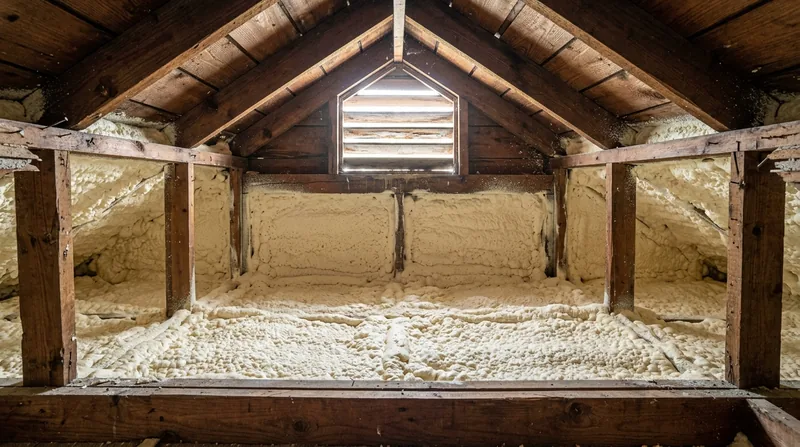




Open cell spray foam insulation in Fort Wayne fills the gaps that fiberglass batts and blown-in cellulose leave behind in older homes and newer attics alike. Fort Wayne's housing stock spans from early-1900s balloon-framed homes in West Central and Forest Park, where heat rises straight through open wall cavities into unvented attics, to postwar ranches with basements and newer subdivisions with bonus rooms over garages. Open cell foam expands to fill irregular framing, stays breathable through humid summer months, and costs less than closed cell while still sealing the air leaks that drive up winter heating bills. In climate zone 5A, where winter cold pushes outward through rim joists and top plates while humid summer reverses that pressure, a breathable foam that controls air movement without trapping moisture is often the right answer. We've installed open cell foam in attic rafters across Fort Wayne since 2014, and we'll tell you plainly when it's the better choice and when closed cell spray foam or blown-in insulation makes more sense for your home.
Why Open Cell Foam Matters in Fort Wayne's Older Homes
Balloon-framed homes built before 1950 in West Central, Lakeside, and Forest Park have tight attics and open wall cavities that let conditioned air escape upward and outward. Postwar ranches across the south and east sides often have full basements with leaky rim joists above them, while newer subdivisions toward Aboite and Huntertown feature bonus rooms over garages where trusses and ductwork carve up the attic space. Open cell foam fills these irregular cavities and seals the air leaks that fiberglass batts cannot reach, while staying breathable enough to let trapped moisture escape during humid months. The result is warmer floors, lower winter heating bills, and better control of the moisture that moves through walls and attics in this climate.
- We fill wall cavities in older homes without tearing out plaster or drywall, using injection foam or open cell in retrofit work.
- We seal attic rafters and rim joists where fiberglass batts leave gaps at corners, edges, and around framing members.
- We control moisture in humid climates by choosing breathable foam that lets vapor move through the assembly instead of trapping it.
- We reduce air leakage at the top of walls, around band joists, and through ceiling penetrations where blown-in insulation settles and gaps reappear.
- We lower heating costs by sealing the paths that heat takes upward and outward through uninsulated rim joists and open attic spaces.
Open cell foam is the answer when air sealing and insulation value matter equally, and when breathability is part of the solution rather than a liability.
Key info: Fort Wayne's climate is IECC zone 5A, cold and humid. Winter heat and moisture push outward through top plates and rim joists, while humid summer reverses that pressure. A breathable foam prevents moisture from being trapped inside wall cavities, which is why open cell often outperforms closed cell in attic retrofits where vapor needs to move.
For more on how insulation and air sealing work together, see our air sealing service page. You can also verify the energy code and thermal barrier rules that apply to your address by contacting the City of Fort Wayne Building Department.
How We Install Open Cell Spray Foam in Fort Wayne Attics and Walls
Open cell foam is sprayed as a liquid and expands on contact with air, filling every corner of a cavity and then being trimmed flush with the framing. We control the thickness, the spray pattern, and the cure environment to ensure the foam bonds properly and off-gasses completely before the home is reoccupied. The process takes a few hours for a typical attic, and the home must stay unoccupied for 24 to 48 hours after spraying while the foam cures and mechanical ventilation removes isocyanate vapors.
- We inspect the attic or wall cavity for moisture, active leaks, or contamination and address those before any foam is sprayed.
- We seal air leaks around ductwork, electrical penetrations, and rim joists before applying the foam to maximize the air-sealing benefit.
- We spray open cell foam at the correct thickness (typically 3.5 to 5.5 inches for R-13 to R-20) and allow it to cure fully before trimming.
- We run mechanical ventilation during and after spraying to remove isocyanate vapor and ensure safe re-entry within 24 to 48 hours.
- We provide a written estimate with R-value and thickness specs so you know exactly what you are getting before work begins.
This step-by-step approach is how open cell foam delivers both air sealing and insulation value without the moisture problems that can occur when breathable foam is installed incorrectly.
Example: A 1920s balloon-frame home in West Central Fort Wayne has open wall cavities running from the basement to the attic. We inject open cell foam into those walls at 3.5 inches, achieving R-13 per cavity while sealing air leaks that fiberglass batts would have missed. The homeowner avoids tearing out plaster, and the breathable foam lets moisture move through the wall assembly in both seasons. See our wall and injection foam page for more on this retrofit approach.
Open Cell Spray Foam Installation Methods and Applications
| Approach | Description | Best for |
|---|---|---|
| Attic Rafter Cavity Fill | Spray open cell foam between rafters to R-20 or higher, then trim flush and install a thermal barrier (drywall or intumescent paint) if required by code. | Vaulted ceilings, cathedral roofs, and sealed attics where air sealing and insulation are both priorities. |
| Wall Cavity Injection Retrofit | Inject open cell foam into existing wall cavities through small holes drilled in the exterior or interior, filling irregular framing without demolition. | Older homes with open cavities, balloon-frame construction, and walls that cannot be opened for traditional batts or blown-in. |
| Rim Joist and Band Joist Sealing | Spray open cell foam in the rim joist cavity above the foundation sill, sealing air leaks and insulating the cold junction where basement meets the floor above. | Basements with cold floors, crawl spaces, and homes where air sealing at the foundation line is the priority. |
| Attic Top-Up Over Existing Insulation | Spray open cell foam over sound fiberglass or cellulose to add R-value and seal gaps, without removing the existing insulation unless it is wet or contaminated. | Homes with settled blown-in insulation, fiberglass batts with gaps, or attics where a cost-effective R-value boost is needed. |
| Garage Ceiling and Wall Cavities | Spray open cell foam in garage ceilings and exterior walls to reduce heat loss to an unconditioned space and improve comfort in rooms above. | Bonus rooms over garages, garage walls adjacent to living space, and detached garages where air sealing is the main goal. |
Open Cell Spray Foam Insulation Cost in Fort Wayne: What to Expect
Open cell spray foam typically costs starting at $0.55 per board foot, with the final price depending on the size of the area, the complexity of the framing, access to the cavity, and whether existing insulation needs to be removed first. A small attic retrofit in a ranch home might run $1,500 to $3,500, while a larger cathedral ceiling or multi-cavity wall injection could reach $5,000 to $8,000 or more. The best way to know what your job will cost is to get a written estimate with R-value and thickness specs, which we provide at no charge within 24 hours of your call.
Factors that move the price up or down include the depth of the cavity (thicker foam costs more), whether we need to remove old insulation first (which adds labor and disposal), the number of penetrations and obstructions we have to work around, and whether the attic or wall is easy to access or requires scaffolding or equipment. Travel within Fort Wayne and surrounding areas is included in our estimate, with no separate mileage charge.
We recommend getting 2 to 3 estimates from different contractors so you can compare not just price but also the R-value, thickness, and workmanship warranty offered. A low estimate with no specs is a red flag, as is a promise of immediate re-entry or a price far below market. For a detailed breakdown of our pricing, see our full pricing page.
What to Look for When Hiring a Spray Foam Contractor Near Fort Wayne
The spray foam insulation market in Fort Wayne includes local independent shops, national franchises, and out-of-state rig-and-run crews that spray a job in an afternoon and are unreachable when the smell will not go away or the foam fails. The best way to protect yourself is to verify the contractor's insurance, get a detailed written estimate with R-value and thickness, check references from recent jobs, and understand what permits and thermal barriers your local building code requires.
- Ask for proof of full insurance coverage (general liability and workers compensation) and verify the policy is current with the insurance company directly.
- Request a written estimate that names the R-value, the foam thickness in inches, and the total board feet to be sprayed, not just a price per square foot.
- Get at least two other estimates so you can compare specs, warranty, and pricing across contractors working in your area.
- Check references from recent jobs in Fort Wayne, New Haven, or nearby towns, and ask about the smell, the re-entry timeline, and whether any issues came up after the work was done.
- Understand permit and thermal barrier rules for your address by contacting your local building department; these vary by city and the contractor should know them for your zone.
A local contractor with a local address, local plates, and roots in the community is more accountable than a franchise or a traveling crew. Call us at (260) 264-8362 or request a free estimate online to see how we compare.
Open Cell Spray Foam Insulation in Fort Wayne: Pricing Guide
| Service | Price | Details |
|---|---|---|
| Open Cell Foam Attic or Wall Retrofit | Starting at $0.55/board ft | Includes inspection, air sealing, foam application, and trimming. Price varies with cavity depth, access difficulty, and whether old insulation must be removed |
| Rim Joist and Band Joist Sealing | Starting at $1,200 | Smaller job with high impact on comfort and heat loss. Typical basement rim joist runs 30 to 60 linear feet and takes one day |
| Garage Ceiling or Bonus Room Foam | Starting at $1,500 | Depends on ceiling area and whether walls are also included. Typical garage ceiling is 400 to 600 square feet |
| Large Attic Retrofit or Wall Injection Project | On estimate | Multi-story homes, cathedral ceilings, or extensive wall cavities require on-site measurement to determine board footage and final cost |
| Travel and Estimate | Free | No mileage charge within Fort Wayne and surrounding service areas. Free written estimate with specs within 24 hours of your call |
Indicative pricing, the exact cost depends on square footage, finish, and site access. Free personalized estimate within 24h at (260) 264-8362.


