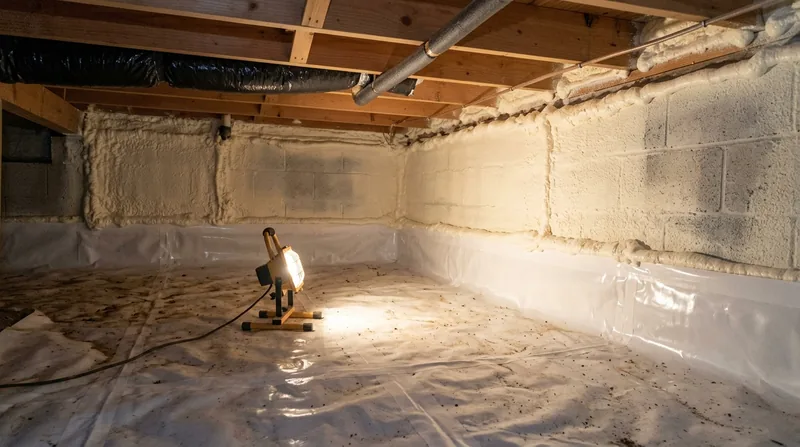




Crawl Space Spray Foam Insulation in Fort Wayne stops cold floors and damp air at the source. Fort Wayne's postwar ranches and newer subdivisions sit on crawl spaces that trap unheated, humid air year-round. In winter, that cold bleeds up through subfloors and rim joists, making living spaces uncomfortable and driving heating costs higher. In summer, moisture from the soil and humid air can rot rim joists and promote mold growth in the band board. We seal the vents, foam the walls and rim joists, and close off moisture so the space stays dry and conditioned through both seasons. This is the difference between a cold first floor and a livable one, and between a rim joist that lasts and one that fails in fifteen years.
Why Crawl Space Insulation Matters in Fort Wayne's Cold, Humid Climate
Fort Wayne sits in IECC climate zone 5A, where winters are cold and summers are humid. Crawl spaces under ranches across the south and east sides of Fort Wayne, and under newer subdivisions pushing toward Huntertown and Aboite, are vented to the outside air by code in older construction. That venting was meant to prevent rot, but it brings in winter cold and summer moisture. The rim joist and band board, the connection between the foundation and the framed floor above, becomes a thermal weak point in winter and a moisture trap in summer. Floors stay cold. Heating bills climb. Over time, moisture rots wood and invites mold.
- Vented crawl spaces pull in cold winter air that chills the floor above and forces the heating system to work harder.
- Summer humidity enters the crawl space through vents and condenses on rim joists, causing wood rot and mold growth.
- Sealing vents and insulating walls and rim joists turns the crawl space into a conditioned buffer that stabilizes floor temperature year-round.
- Closed crawl spaces with foam insulation reduce heating and cooling load on the entire house because the rim joist and band board are no longer a thermal bridge to the outside.
The result is warmer floors in winter, drier conditions in summer, and lower energy bills every month.
Fort Wayne example: A 1970s ranch in Leo-Cedarville or New Haven with a vented crawl space typically loses 15 to 25 percent of its heating energy through the rim joist and band board. Sealing and insulating that space with closed cell foam stabilizes subfloor temperature and cuts heating costs noticeably by the first winter.
For more on how to protect your rim joist and band board, see our Rim Joist and Band Joist Spray Foam service.
How We Insulate and Seal Crawl Spaces in Fort Wayne
Crawl space insulation starts with understanding what you have. We inspect the space, check for active moisture, standing water, or contamination, and measure the walls and rim joist. If the space is wet or contaminated, we walk away. We do not spray over moisture. If the space is dry and ready, we seal rim vents, install a vapor barrier over the soil if needed, and spray closed cell foam on the walls and rim joist to create an air seal and thermal barrier. The foam sets in place and hardens, turning the crawl space into an insulated, sealed buffer between the outside and your living space above.
- We inspect the crawl space for moisture, standing water, and structural damage before we commit to the job.
- We vent-seal the crawl space openings to the outside to stop cold and humid air from entering.
- We spray closed cell foam on the rim joist, band board, and crawl space walls to create a continuous air and thermal seal.
- We apply the foam in controlled passes with proper drum temperature and air ratio to achieve specified R-value and thickness without voids or thin spots.
- We set a mechanical ventilation system during cure and post a re-entry window of 24 to 48 hours to allow off-gassing before occupancy.
The entire process turns a vented, leaky crawl space into a sealed, insulated part of your conditioned envelope.
Local example: A 1,200-square-foot ranch in Huntertown or Fort Wayne's Lakeside neighborhood with a 1,000-square-foot crawl space typically takes one to two days. We vent-seal the openings, spray 2 to 3 inches of closed cell foam on the rim and walls, and set up ventilation. The homeowner can re-enter after 24 to 48 hours. First winter, floors are noticeably warmer.
Learn more about our Closed Cell Spray Foam Insulation process and specifications.
Crawl Space Insulation Methods and Materials
| Approach | Description | Best for |
|---|---|---|
| Closed Cell Foam on Rim and Walls | High-density foam sprayed 2 to 3 inches thick on the rim joist, band board, and crawl space walls. Creates an air seal and thermal barrier. R-value approximately 6 to 7 per inch. | Crawl spaces in cold climates where moisture control and thermal performance are both critical. Fort Wayne ranches and subdivisions. |
| Vent Sealing and Rim Joist Foam | Seal crawl space vents with foam blocks or spray foam, then insulate the rim joist and band board with closed cell foam. Stops outside air infiltration at the source. | Vented crawl spaces where the priority is stopping cold air and moisture entry through foundation vents. |
| Vapor Barrier and Foam System | Lay a vapor barrier over the soil to block moisture, then spray foam on the rim and walls. Combines moisture control from below with air sealing from above. | Crawl spaces with moderate soil moisture where encapsulation and insulation are both needed. |
| Full Rim and Wall Foam Enclosure | Spray closed cell foam on all exposed surfaces: rim joist, band board, foundation walls, and vents. Creates a fully sealed, insulated crawl space. | Crawl spaces where complete air sealing and thermal control are the goal. Most effective for Fort Wayne's cold winters. |
Each approach is selected based on the size of the space, the condition of the foundation, and your heating and moisture control goals. We recommend closed cell foam for rim and wall insulation because it delivers both air sealing and R-value in a single application.
Crawl Space Spray Foam Insulation Cost in Fort Wayne: What to Expect
Crawl space spray foam insulation in Fort Wayne typically starts at $2,500 to $3,500 for a small to medium crawl space (500 to 1,000 square feet) with straightforward access and dry conditions. Larger spaces, or spaces with limited access, higher moisture concerns, or structural complications, cost more. The price reflects the amount of foam applied, the complexity of the space, and the time required for proper air sealing and ventilation during cure.
Several factors move the cost up or down:
- Size of the crawl space in square feet determines the volume of foam and labor hours required.
- Access and crawlway height affect how quickly we can move through the space and apply foam efficiently.
- Presence of obstructions such as HVAC ducts, plumbing, or electrical conduit requires careful masking and work around existing systems.
- Moisture conditions and need for vapor barrier installation add preparation time and materials to the scope.
- Rim joist condition and whether we need to address rot or damage before foaming affects the total cost.
The best way to understand the cost for your crawl space is to get a written estimate. We measure on site, specify the R-value and thickness you need, and give you a firm price before we start. See our full pricing overview for more detail, and call us at (260) 264-8362 for a free, no-obligation estimate.
Crawl Space Spray Foam Insulation Near Me: What to Look for When Hiring a Contractor in Fort Wayne
Finding the right spray foam contractor matters because poor work shows up as odor, incomplete coverage, or moisture problems months after the job. When you call a contractor to estimate your crawl space, ask direct questions. Request a written estimate that specifies the R-value, thickness, and coverage area. Ask how they handle moisture and what they do if they find standing water or contamination. Verify they carry full insurance and can provide a certificate of insurance. Check references from recent crawl space jobs in Fort Wayne or nearby towns like New Haven, Huntertown, or Leo-Cedarville. Ask about their re-entry protocol and ventilation setup during cure. A professional contractor will answer all of these without hesitation.
- Request a written estimate with R-value and thickness specifications, never a vague per-board-foot quote without on-site measurement.
- Verify that the contractor carries full insurance and can provide proof of coverage before work begins.
- Ask for references from at least two or three recent crawl space jobs and follow up with those homeowners about their experience and results.
- Confirm that the contractor will set up mechanical ventilation during the cure period and enforce a 24 to 48 hour re-entry window.
- Understand permit requirements for your specific address by calling the Fort Wayne building department at 311 or your local city office, and verify that your contractor can help you navigate what applies.
- Check for HOA architectural restrictions if your home is in a master-planned community, though most HOAs do not govern crawl space work.
A contractor who walks away from a wet crawl space and refuses to spray over moisture is the one you want. That discipline is the mark of a professional who knows the trade. Contact us for a free estimate and to discuss your crawl space condition and goals.
Crawl Space Spray Foam Insulation in Fort Wayne: Pricing Guide
| Service | Price | Details |
|---|---|---|
| Small crawl space (500-750 sq ft) | Starting at $2,500 | Closed cell foam on rim and walls, straightforward access, dry conditions, includes vent sealing |
| Medium crawl space (750-1,200 sq ft) | Starting at $3,500 | Closed cell foam coverage, vapor barrier if needed, moderate access, includes full rim and wall insulation |
| Large or complex crawl space | On estimate | Spaces over 1,200 sq ft, limited access, moisture concerns, or structural complications require site inspection for accurate pricing |
| Travel and setup | Included | No separate mileage or travel fee within Fort Wayne and surrounding service areas |
| Free estimate | No obligation | Written estimate with R-value and thickness specs, response within 24 hours, call (260) 264-8362 |
Indicative pricing, the exact cost depends on square footage, finish, and site access. Free personalized estimate within 24h at (260) 264-8362.


