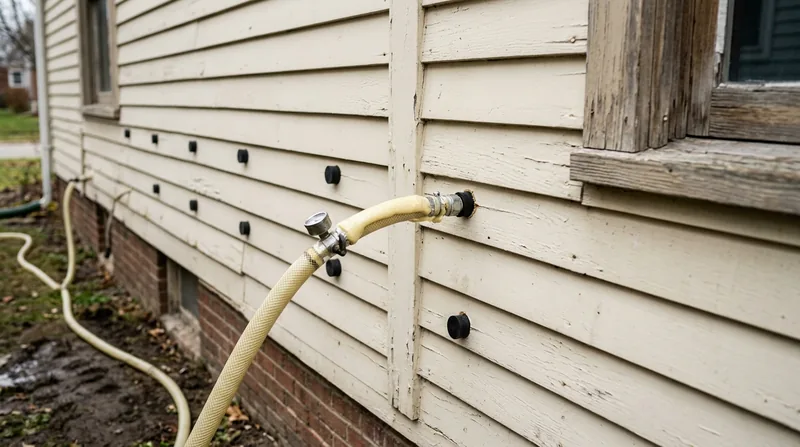




Wall & Injection Foam Insulation in Fort Wayne restores heat retention to the closed-wall cavities of early-1900s balloon-framed homes that dominate West Central, Lakeside, and Forest Park. These houses were built with open stud bays that rise from basement to attic, and decades of heating season have let warm air and moisture escape through those cavities, driving up winter gas bills and leaving upper floors cold. Injection foam fills those voids without tearing out plaster or siding, sealing the wall from the inside and holding heat where it belongs. Fort Wayne's IECC zone 5A climate makes this retrofit one of the most cost-effective ways to reclaim comfort in homes that were never designed to hold conditioned air. We drill small access holes, inject closed-cell or open-cell foam into the cavity, and patch the siding so the work is invisible from the street.
Why Wall & Injection Foam Matters in Fort Wayne's Older Housing Stock
Fort Wayne's West Central and Lakeside neighborhoods are built on balloon-framed construction, a technique that ran vertical studs from sill to roof without blocking off the wall cavities. In winter, warm air rises through these open channels and escapes into the attic. In summer, humid outdoor air can reverse that flow and carry moisture into the wall, risking mold and rot over time. Injection foam closes those cavities permanently, stops the air leakage, and lets your heating and cooling system work as intended. Older ranches in Leo-Cedarville and New Haven often have partial insulation or settled batts that have lost their R-value, and injection foam tops up those walls without demolition.
- Stops air leakage through open stud bays that run the full height of the wall.
- Adds thermal resistance without removing plaster, drywall, or exterior siding.
- Blocks moisture migration and reduces the risk of mold and wood decay in the cavity.
- Works in homes where the wall cavity is inaccessible from the attic or basement.
- Improves comfort on upper floors by holding heat in the conditioned space.
Injection foam is the retrofit answer for homes where the wall framing is a thermal sieve and replacement is not an option.
Key info: Fort Wayne building code governs ignition barriers and thermal barriers for spray foam. The fifteen-minute thermal barrier requirement applies to interior foam and is verified by the Fort Wayne building department at inspection. Always defer to your local building official on what applies at your address. Learn more at the City of Fort Wayne website.
How We Inject Foam Into Fort Wayne Walls: A Step-by-Step Process
Injection foam begins with a site visit to locate the wall cavities, assess siding condition, and identify any obstacles like electrical wiring or plumbing. We drill small 1-inch holes in the exterior siding at intervals, inject foam into the cavity using commercial equipment, and patch the holes so the work is not visible. The foam expands to fill the entire cavity, sealing air leaks and adding R-value. For a two-story home in West Central Fort Wayne with 1,200 linear feet of exterior wall, a typical job takes one to two days depending on access and cavity depth.
- We inspect the wall cavity using a borescope to confirm depth and confirm no moisture or contamination.
- We drill small access holes through the siding at intervals determined by cavity width and foam equipment specifications.
- We inject foam at controlled pressure and flow rate, filling the cavity from bottom to top.
- We allow the foam to cure fully before patching the holes with matching siding repair.
- We verify thermal barrier compliance with the local building code before the job is closed.
The entire process is non-invasive, reversible in principle, and leaves no interior mess or odor once the curing window closes.
Local example: A 1920s Colonial in Lakeside with 8-inch balloon-framed walls and no insulation received injection foam in the north and west walls, the faces that take winter wind. The homeowner reported 18 percent lower gas bills the following winter and no cold drafts on the second floor. The work took two days and required no interior disruption.
If you are considering attic spray foam insulation as a companion retrofit, we can coordinate both projects to seal the entire thermal envelope at once.
Injection Foam Methods and Applications
| Method | Description | Best For |
|---|---|---|
| Closed-Cell Injection Foam | High-density foam at 1.5 to 2.0 pounds per cubic foot, injected into cavities to expand and fill voids completely. R-value typically 6 to 7 per inch. Does not require ventilation and resists moisture migration. | Walls with moisture risk, below-grade cavities, and homes where air sealing and vapor control are priorities. |
| Open-Cell Injection Foam | Lower-density foam at 0.5 to 1.0 pounds per cubic foot, injected to fill cavities with a softer, more flexible foam. R-value typically 3.5 to 4 per inch. Vapor-permeable and allows drying if moisture enters. | Interior walls in dry climates or as a cost-effective retrofit where moisture risk is low and vapor permeability is acceptable. |
| Retrofit Injection into Existing Cavities | Foam injected into walls that contain failed or settled fiberglass batts, creating a composite insulation layer. Fills voids left by compression and settling. | Older homes with partial insulation, homes where the original batts have degraded, and walls where access to remove old material is not practical. |
| Cavity Fill with Injection Ports | Multiple injection holes drilled to ensure complete fill of deep or wide cavities, with foam expanding and consolidating between passes. Allows verification of fill depth before final hole patching. | Two-story homes, walls taller than 16 feet, and cavities wider than 12 inches where gravity and foam settle require staged injection. |
Wall & Injection Foam Insulation Cost in Fort Wayne: What to Expect
Injection foam insulation in Fort Wayne typically starts at $2 per square foot of wall area being treated, but the actual cost depends on cavity depth, foam type, and siding condition. A 1,200-square-foot exterior wall on a two-story home in West Central Fort Wayne would fall in the $2,400 to $3,600 range for closed-cell injection foam, while open-cell would run 15 to 20 percent lower. If the siding requires repair or the cavity has obstacles like wiring or plumbing, the cost moves upward. Walls with existing failed insulation that must be removed first add labor and disposal fees.
The best way to understand your actual cost is to get written estimates from two or three contractors that specify the foam type, R-value per inch, thickness per pass, and total square footage being treated. A complete estimate should also note whether permits are required in your city and who handles them. Travel within Fort Wayne and surrounding areas is included in our pricing, and a free estimate is available within 24 hours at (260) 264-8362.
Visit our full pricing overview for additional detail on what moves costs up or down for injection foam and other insulation retrofits.
What to Look for When Hiring a Spray Foam Contractor Near Fort Wayne
Choosing the right spray foam contractor is the difference between a retrofit that holds for decades and one that fails, smells, or leaves you with no one to call when problems arise. Verify that any contractor you interview is fully insured and carries general liability coverage that covers spray foam work. Ask for references from recent jobs in your neighborhood, and call at least two to ask about cure time, odor, and whether the contractor returned to address any questions after the work was complete. Get multiple written estimates that show R-value, thickness per pass, and total board feet or square footage, not just a price per board foot with no detail.
- Confirm that the contractor explains what permits are required at your address and who handles them with the local building department.
- Ask whether the contractor uses mechanical ventilation during cure and what the re-entry window is for the space being treated.
- Verify that the estimate specifies foam type, closed-cell or open-cell, and the manufacturer or system being used.
- Check whether the contractor has experience with your specific wall type, balloon-framed versus platform-framed, and with siding repair.
- Ask about workmanship warranty and what it covers if the foam settles, shrinks, or does not reach the stated R-value.
A contractor who avoids questions, offers a price far below market, or promises immediate re-entry is a signal to walk away and call the next estimate.
For a free, no-obligation estimate on wall and injection foam insulation near Fort Wayne, contact us today or call (260) 264-8362.
Wall & Injection Foam Insulation in Fort Wayne: Pricing Guide
| Service | Price | Details |
|---|---|---|
| Closed-Cell Injection Foam | Starting at $2.50/sq ft | High R-value, moisture-resistant foam for exterior walls; cost varies with cavity depth and siding repair needs |
| Open-Cell Injection Foam | Starting at $1.75/sq ft | Lower-cost retrofit option for interior walls where vapor permeability is acceptable and moisture risk is low |
| Retrofit Injection into Failed Insulation | Starting at $2.25/sq ft | Topping up settled batts or removing old insulation first; labor and disposal fees apply if removal is required |
| Multi-Story or Complex Cavities | On estimate | Two-story walls, deep cavities, or walls with electrical and plumbing obstacles require site inspection for accurate pricing |
| Travel and Estimate | Free | No travel charge in Fort Wayne and surrounding service areas; free written estimate within 24 hours at (260) 264-8362 |
Indicative pricing, the exact cost depends on square footage, finish, and site access. Free personalized estimate within 24h at (260) 264-8362.


